AI-Enabled Software Prototyping & Development Acceleration
TL;DR

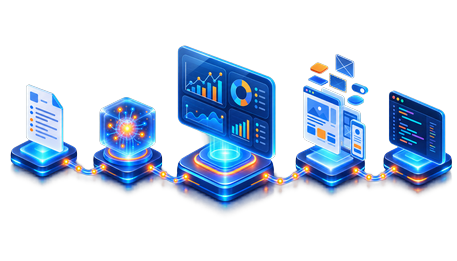
A dense Business Requirements Document had to become a demonstrable software concept. Only 20 of the original 45 project days remained to make it happen.
ChatGPT converted BRD requirements into structured, screen-level design prompts. Figma AI used those prompts to generate UI concepts, dashboards, and layouts at speed.
The same AI-assisted design work extended into development: Figma AI generated approximately 95% of the initial Angular front-end code structure.
Within roughly 15 days, 90+ prototype pages were completed. The client saw both an interactive prototype and a working front-end demonstration.
Every AI-generated output was reviewed and validated by human designers before reaching the client. AI accelerated the work - people made the decisions.
Key Takeaways
Requirements-to-design is a translation problem: ChatGPT acted as a communication layer, turning BRD language into structured, screen-level prompts that Figma AI could act on directly.
Speed came from a disciplined loop, not one-shot generation: Each AI-generated screen went through review, gap identification, and prompt refinement before it was validated into the prototype.
The prototype doubled as a front-end starting point: Figma AI generated roughly 95% of the initial Angular code structure. The same design work that proved the concept gave developers a head start on implementation.
Two demonstrations, one decision: Showing an interactive prototype alongside a working front-end structure let the client judge both the experience and its technical feasibility at once.
Compression made the AI use case obvious: With only 20 of 45 days left, AI's impact showed up exactly where manual work bottlenecks - requirement structuring and screen creation.
Human judgment set the quality bar: AI outputs were never treated as final; a designer's evaluation of usability, consistency, and requirement alignment determined what moved forward.
Relevant Article

Autonomous Machine Revolution & Rise of Machine Agency - 2026
Behavioural Design Pattern

Whitepaper on Seat Layout Workflow for Movie Ticket Booking Mobile App
Kalpita Technologies® is a Registered Trademark © 2026 All Rights Reserved.