Tech Geek Ed. 7
TL;DR

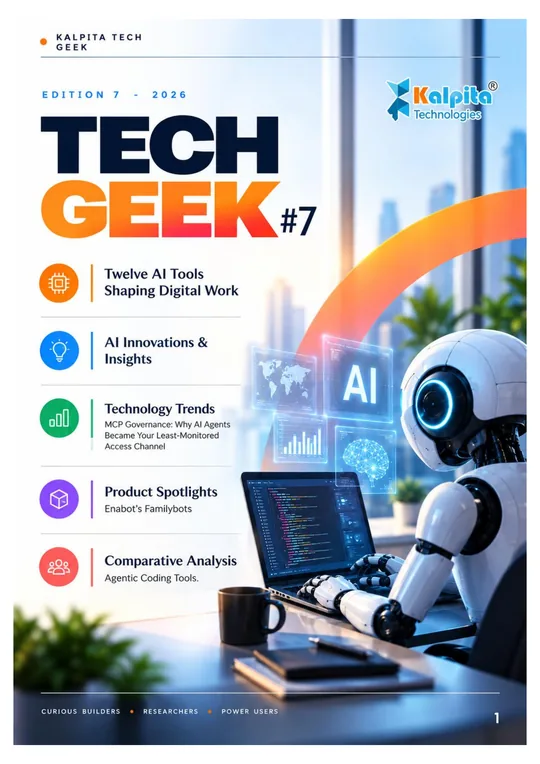
Tech Geek Edition 7 explores the latest AI innovations, technology trends, AI-powered products, and agentic coding tools shaping digital work in 2026.
Discover how Generative AI is transforming protein design, enabling researchers to create new biological structures and explore applications across healthcare, sustainability, and clean energy.
Explore practical AI tools for productivity, coding, research, marketing, design, meetings, and automation, with a focus on choosing tools based on real workflow needs.
See how AI browser plugins can streamline everyday work by reducing repetitive tasks across research, writing, meetings, and knowledge management.
Learn how agentic AI is enabling self-healing supply chains, moving logistics from passive monitoring toward autonomous disruption detection, decision-making, and recovery.
Understand how SciSpace AI can simplify academic research through literature analysis, document editing, citation management, and cross-paper insights.
Explore 12 emerging AI tools that are moving beyond chatbots to support software development, app creation, productivity, design, marketing, and digital workflows.
Understand why MCP governance and AI agent security are becoming critical as enterprise AI agents gain greater access to business systems and data.
Get a closer look at AI translator earbuds, including Timekettle W4/W4 Pro and Anfier M3, and their capabilities for real-time translation, meetings, travel, and multilingual communication.
Explore Enabot Familybots, including EBO Max and ROLA Mini, which combine AI-powered monitoring, mobility, two-way communication, and smart home or pet-care capabilities.
Compare agentic coding tools across model strategy, pricing, enterprise controls, audit logs, deployment options, and autonomy to understand how today's AI coding landscape differs across platforms.
Key Takeaways
AI is moving from assistance to action: Modern AI tools are increasingly capable of executing tasks, creating software, managing information, and supporting end-to-end digital workflows.
Generative AI is expanding beyond content creation: AI-driven protein design demonstrates how generative models can be applied to scientific and biological engineering.
AI adoption requires purposeful tool selection: Building a focused AI toolkit around specific business or personal workflows can be more practical than adopting numerous overlapping tools.
Agentic AI is changing enterprise operations: Self-healing supply chains illustrate how AI agents can detect disruptions, evaluate alternatives, and execute recovery actions through connected systems.
AI governance must evolve with agent autonomy: Identity controls, ephemeral credentials, access management, logging, and human approval are highlighted as key controls for governed MCP environments.
Enterprise AI needs security by design: As AI agents interact with business applications and sensitive data, governance and authorization need to be integrated into the AI workflow rather than treated as an afterthought.
AI-powered research is becoming more connected: Tools such as SciSpace bring paper discovery, literature reviews, document editing, citation management, and research analysis into a consolidated workflow.
AI is reshaping software development: Agentic coding tools now span autonomous coding, debugging, testing, multi-model development, enterprise deployment, and on-premise or hybrid environments.
AI-powered devices are entering everyday use: Translator earbuds and mobile Familybots demonstrate how AI is increasingly being embedded directly into consumer hardware.
The practical AI advantage comes from workflow integration: Across the edition, the emphasis is on applying AI to meaningful problems while retaining human judgment, validation, governance, and oversight.
Frequently Asked Questions
More TechGeeks

Edition 6

Edition 4

Edition 1
Kalpita Technologies® is a Registered Trademark © 2026 All Rights Reserved.