Product Case Study · Sovereign AI & Data Governance
Keeping data out of shadow AI — an offline PII firewall.
From a hackathon idea to Kalpita Sentinel: a fully developed, on-premise AI data firewall that detects, masks and grades personally identifiable information before it ever reaches ChatGPT, Copilot, Claude or any cloud model.

≥ 0.91
entity-level F1
≤ 3 s
p95 latency per chunk
Verifiably
offline, provably
$0
per scan, per seat
Overview
Six things Sentinel guarantees about your data
Data never leaves the building.
Sentinel detects, masks, classifies and reports sensitive data on-device before it reaches any AI tool.
Hybrid by design.
Rule-based identification, combined with custom India-first recognizers and an on-device reasoning stage, writes a Red/Amber/Green verdict and a cited rationale.
Built for the regulation.
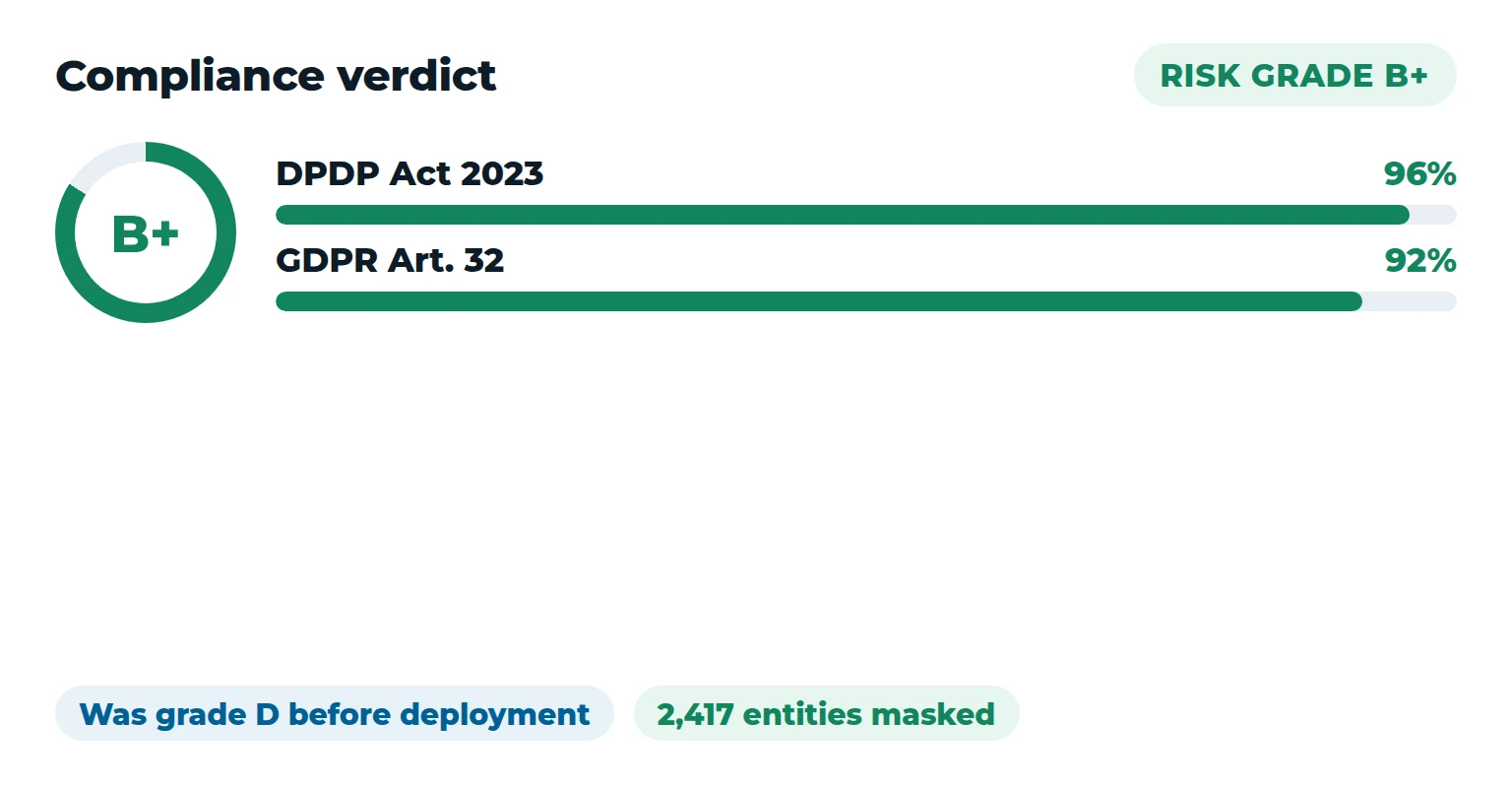
Engineered for India’s DPDP Act 2023 — ₹250 crore per violation, full enforcement 13 May 2027 — and mapped to GDPR, HIPAA, PCI-DSS, CCPA/CPRA, SOC 2, ISO 27001/27701, NIST 800-122 and FERPA.
Laptop-class, zero cloud cost.
Runs on a developer laptop with no GPU and no internet, at $0 per scan, scaling to an air-gapped enterprise server.
Proven outcomes.
≥ 0.91 entity-level F1, ≤ 3 s p95 latency, and a masked file, verdict and audit log in under ten seconds — measured offline.
Fully developed.
Every modality ships — text, documents, spreadsheets, PDFs, images, audio and video — with reversible tokenization, multilingual coverage and a no-code recognizer builder.
Summary
The leak happens at the prompt. Sentinel stops it there.
Kalpita Sentinel is an offline, on-premise PII governance scanner — an AI data firewall that detects, masks and grades sensitive data before it ever leaves a user’s device. Built as a Kalpita internal innovation, it closes the fastest-growing enterprise data-leak channel of 2026: employees pasting customer, financial and health data into generative-AI tools. Industry data shows 18% of employees paste corporate data into GenAI tools, and over half of those pastes contain sensitive content (LayerX, 2025), while India’s DPDP Act now carries penalties of ₹250 crore per violation. Sentinel runs entirely on a laptop — no cloud, no internet, no per-scan cost — and returns a masked file, a Red/Amber/Green verdict and an audit log in under ten seconds. It is the pre-flight check every enterprise needs before a single prompt leaves its network.
Product profile
At a glance
This is a Kalpita internal-innovation story — Kalpita is both the builder and the first customer. The same teams that ship enterprise AI for regulated clients hit the shadow-AI problem first-hand, then built Sentinel to solve it.
- Product
- Kalpita Sentinel
- Industry
- AI-first technology — custom software, cloud and AI/ML engineering — with deep specialization in InsurTech, FinTech and HealthTech, the regulated industries where PII governance is non-negotiable.
- Size & profile
- 130+ AI/ML specialists, 8+ years of delivery, offices in Bengaluru and Austin, SOC 2 (AICPA) certified, ISO certified, Great Place to Work, Clutch 4.7.
- The challenge Kalpita set itself
- give regulated clients — and its own engineers — the productivity of generative AI without leaking regulated data to third-party models.
- Origin
- From a hackathon idea to a fully developed on-premise product
Technical approach
The engineering behind the firewall
- Everything on the device
- Sentinel’s central design decision is that everything runs on the device. That constraint drove the rest of the engineering.
- Deterministic + reasoning
- Pure pattern matching is fast and never hallucinates, but it cannot read context. A hosted language model reads context well but is slow, expensive, and sending data to one would defeat the product’s entire purpose. Sentinel combines deterministic recognition with a small on-device reasoning stage, so speed, accuracy and explainability are delivered together rather than traded off.
- No per-scan fee
- Everything is assembled from openly licensed components running locally rather than from metered third-party AI services, which is why there is no per-scan fee and why offline operation can be demonstrated rather than asserted.
- What Kalpita built
- As distinct from the components it runs on: the detection workflow and how the stages interact, the India-specific recognizer coverage, the compliance-clause mapping, the audit evidence model, the fairness monitoring, the degradation behavior, the no-code recognizer builder, the guardrail integrations, and the three deployment packages.
- Shared under NDA
- Component inventory, model selection, detection sequencing, tokenization mechanics, caching behavior and evaluation methodology are shared under NDA during a technical evaluation.
The challenge
The problem we solved
Industry data shows 18% of employees paste corporate data into GenAI tools — and under India’s DPDP Act 2023 each violation carries a ₹250 crore ceiling.
Generative-AI adoption has outrun governance. The leak is happening today, the regulator is awake, and most enterprises are still unprotected.
Shadow AI
industry data shows 77% of enterprise LLM use is ChatGPT, 18% of employees paste corporate data into GenAI tools, and 34.8% of ChatGPT inputs now carry sensitive data, up from 11% in 2023 (LayerX 2025; IBM 2025).
Regex gaps
pattern matching catches a PAN or an Aadhaar number, but not a surname in a sentence or a quasi-identifier combination — exactly the leaks an auditor cares about.
Cloud risk
every cloud LLM call is metered, and every prompt with PII is a data-residency and breach-notification risk.
₹250 crore
dPDP Act 2023 (₹250 crore per violation), GDPR, HIPAA and PCI-DSS all apply the moment sensitive data reaches a third-party model; full DPDP enforcement begins 13 May 2027 with no grace period.
Fragmented
security and compliance leads needed one tool — drag-and-drop simple, yet auditable enough for an ISO 27701 review.
The solution
A hybrid detector that never touches the network.
Sentinel turns an uncontrolled AI habit into a governed AI workflow — deployed inside the environment and configured to each customer’s industry, languages, data sources and compliance regime.
Offline by design
No telemetry, no internet, demonstrable with an airplane-mode toggle. Sentinel runs on openly licensed software components; licensing details are provided during procurement.
Rule-based identification
Structured identifiers are recognized deterministically and effectively instantly, with custom India-first recognizers, and never hallucinated.
Context-aware reasoning
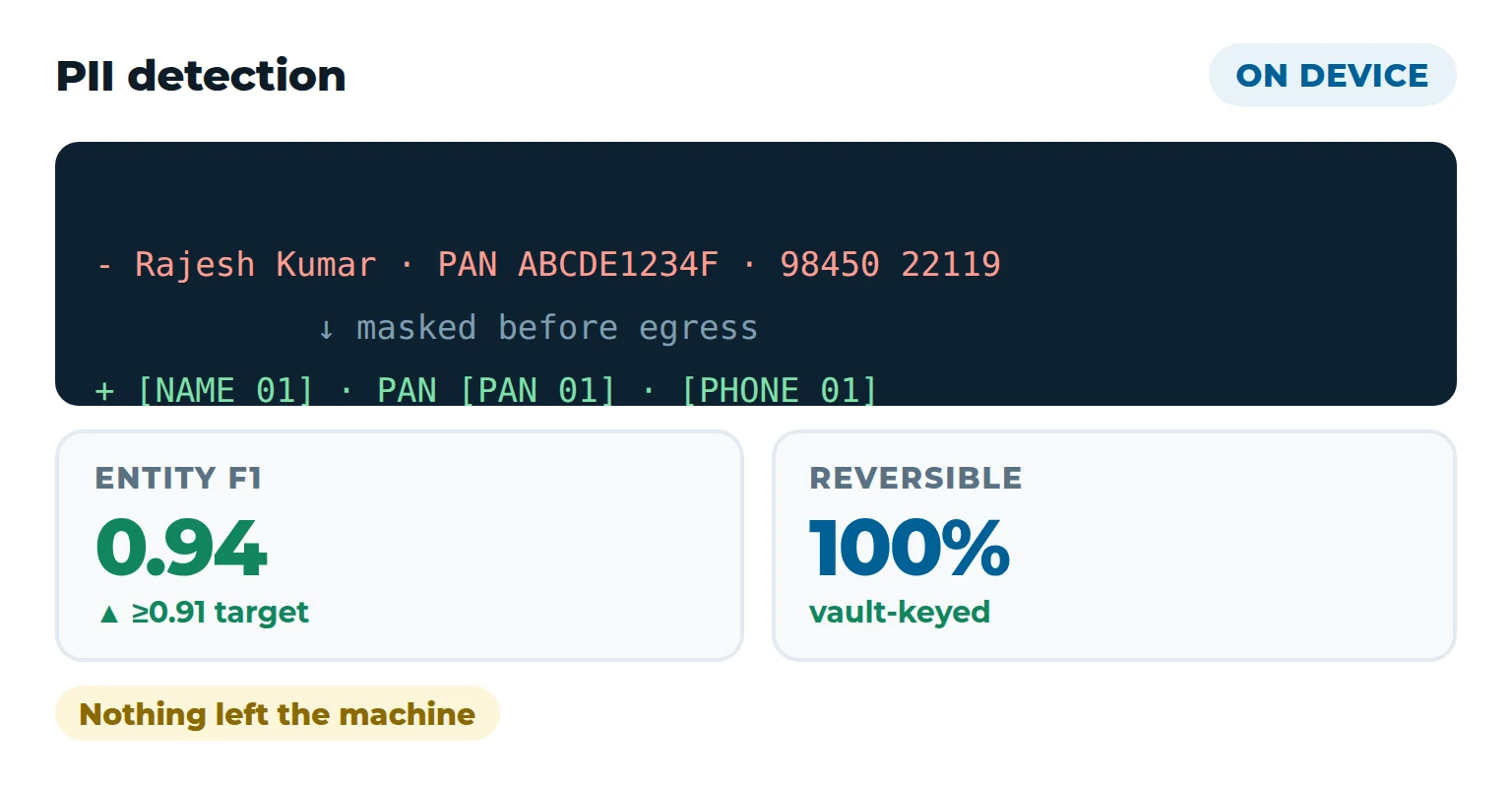
An on-device reasoning stage resolves names in sentences, indirect identifiers and multilingual text, proposes masks, writes a one-sentence rationale, and assigns the Red / Amber / Green verdict.
Reversible tokenization
Each entity becomes a stable token that can be swapped back inside the customer’s environment, so masked text can safely reach any cloud model, then be rehydrated locally.
A compliance citation on every entity
Every flagged item carries the clause it triggers — ’DPDP §2(t)’, ’GDPR Art 4(1)’, ’HIPAA 164.514(b)(2)’ — so the audit log is the evidence a regulator asks for.
Deploy where your data lives
Choose a one-click Windows desktop app for individuals, a container-packaged service with a browser-based interface for teams, or an air-gapped server deployment for enterprises and government organizations.
Inside the product
What ships in Sentinel
Every modality an enterprise actually handles — text, documents, spreadsheets, PDFs, images, audio and video — with an audit row behind each scan.
Every data source, one engine
text, CSV/Excel, JSON/XML, Word; text and scanned PDFs (OCR); images as text and as PII (faces, ID cards, signatures); audio and video via speech-to-text and frame extraction.
India-first PII coverage
Aadhaar, PAN, GST, IFSC, voter ID and Indian mobile formats, alongside multilingual OCR most global tools omit.
Reversible tokenization, caching, and streaming
safe round-trips to cloud models, response caching, and streaming output that halves perceived latency.
No-code custom-recognizer builder
a compliance lead adds a new pattern through a regex builder in the UI, with no engineering ticket.
One-click audit log
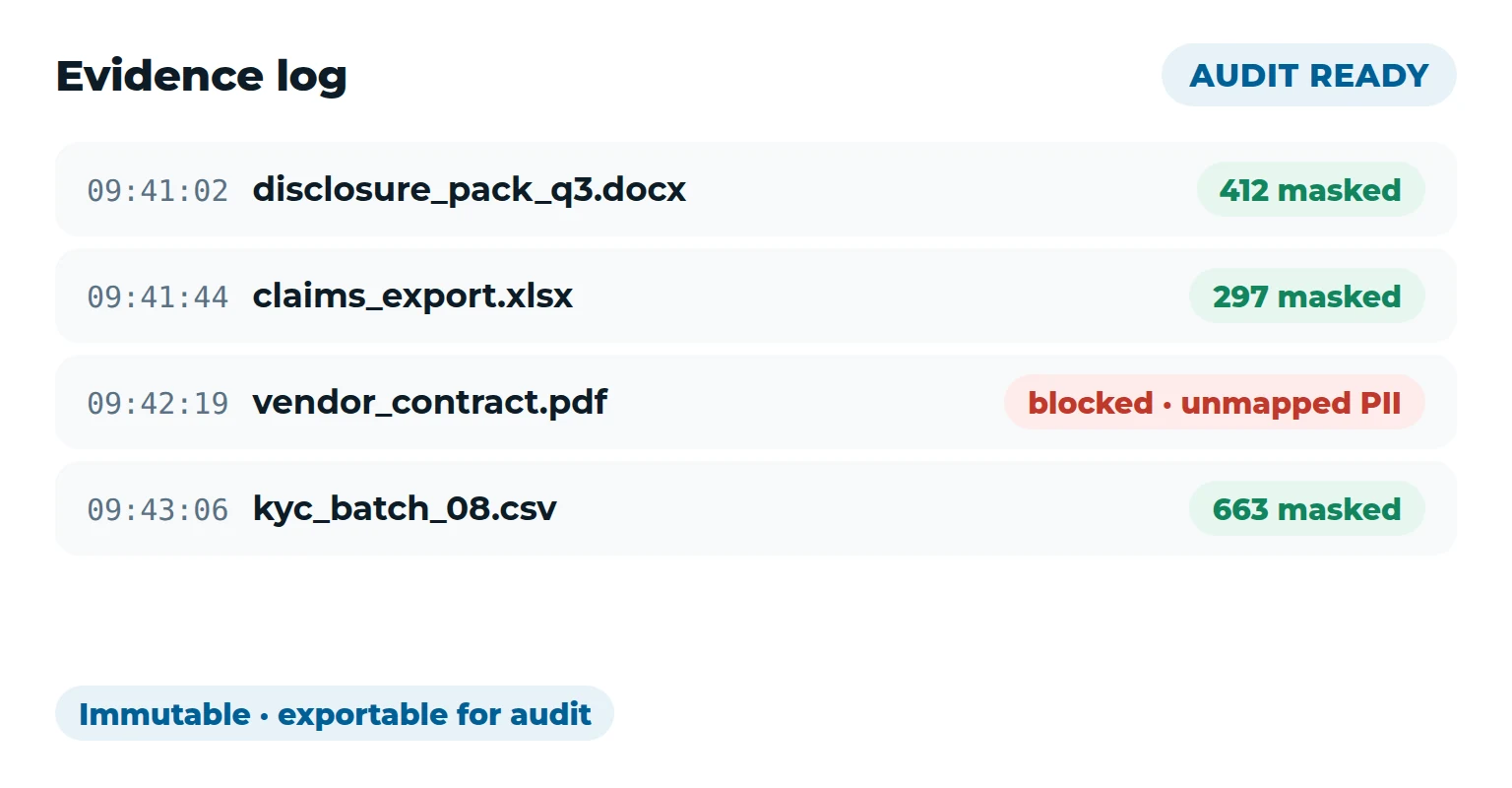
every scan emits a timestamped Excel/CSV row recording the file, the entities found and the verdict.
Multilingual coverage and fairness guardrails
non-English text is covered as a first-class case; precision and recall are tracked by name origin to catch bias.
Graceful degradation
if the reasoning model times out, Sentinel returns the deterministic result with a clear warning and a conservative verdict.
Guardrail modes for the whole AI stack
a browser extension intercepts pastes into ChatGPT; an IDE plugin scans prompts; a RAG pre-ingestion mode scrubs documents before embedding; an egress guardrail screens agent and MCP-server outputs.
Inside Kalpita Sentinel
Results
What Sentinel delivers, measured
Every figure below was measured offline, on laptop-class hardware, and verified against a separate evaluation set.
Detection quality
≥ 0.91 F1
≥ 0.91 entity-level F1 on a 100-item evaluation set spanning structured, contextual, multilingual, adversarial, and clean text — verified by a separate output-verification team
Latency
≤ 3 s p95
≤ 3 s p95 latency per document chunk on laptop-class CPU, with rule-based identification responding effectively instantly
Cost
No per-scan fee
against a cloud equivalent, a 5,000-employee deployment avoids roughly $108,000 a year in inference fees — before counting breach liability removed.
Network
Verifiably offline
an airplane-mode toggle and zero telemetry let a regulator watch the network stay dark while a document is scanned.
Regulatory exposure
Reduced at the point of leak
one masked KYC transcript keeps Aadhaar, PAN and account data out of a cloud model and out of DPDP scope.
Audit trail
Under 10 sec
a masked file, a compliance verdict and a logged evidence row in under ten seconds.
Conclusion
Sovereign AI, proved with an airplane-mode toggle.
Kalpita Sentinel proves a thesis Kalpita lives by - the safest AI is the one that never sees your secrets in the first place. By keeping detection, masking, and grading entirely on-device, Kalpita gives regulated enterprises the productivity of generative AI without the data-leakage liability — at zero per-scan cost, on hardware they already own. The journey from a single hackathon weekend to a fully developed, multi-modal platform is the clearest expression of how Kalpita works: practical innovation, shipped with discipline, governed by evidence — and a preview of the pipeline, as more AI products and solutions graduate from Kalpita’s continuous R&D.
FAQ
Frequently asked questions

See it live
See it run offline.
Book a 30-minute sovereign-AI readiness call and watch a document get masked, graded and logged with the network switched off.